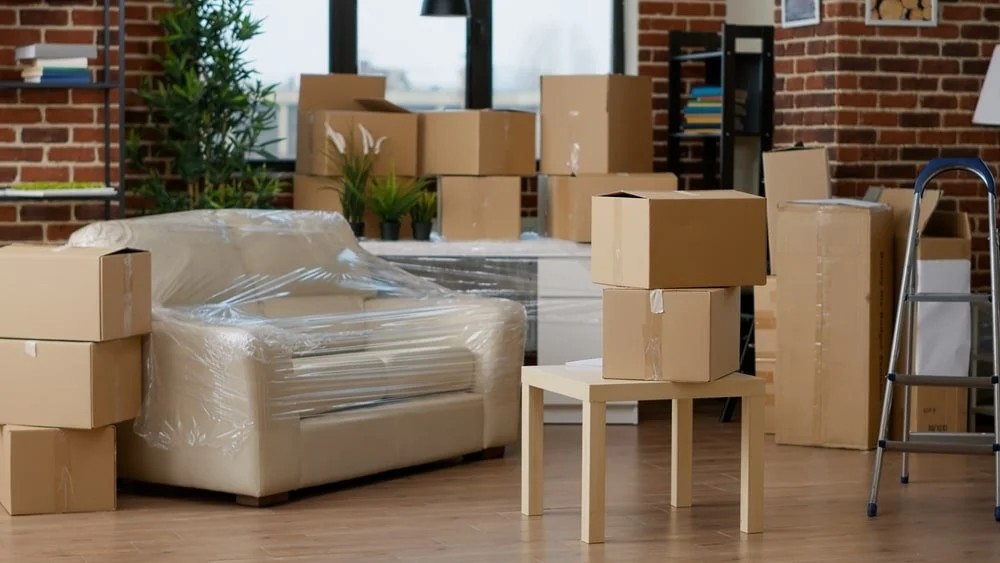
The most affordable way to ship boxes across the country depends on how many boxes you have and what they weigh together. For one to four light boxes, a parcel service such as USPS Ground Advantage, UPS Ground, or FedEx Ground usually costs the least. Once your boxes total about 150 pounds or more going to one address, one consolidated freight shipment usually beats paying for a separate label on every box. If a chair or dresser joins the boxes, a small-load service fits better.
Compare Your Options for Shipping Boxes Cross Country
Here is how to ship moving boxes cross country with each method, per the carriers’ own rules.
- USPS Ground Advantage: best for 1 to 4 small or medium boxes; limits 70 lb per box and 130 inches in length plus girth; typical transit 2 to 5 days.
- USPS Priority Mail: best for small, dense boxes, since Flat Rate boxes ship up to 70 lb to any state at one price; limits 70 lb and 108 inches; typical transit 2 to 3 days.
- USPS Media Mail: best for boxes of books and other eligible media only; limits 70 lb and 108 inches, and USPS may open the box to check; typical transit 2 to 8 days.
- UPS Ground and FedEx Ground: best for heavier boxes; limits 150 lb, 108 inches long, and 165 inches in length plus girth, and UPS adds Additional Handling to any box over 50 lb; typical transit 1 to 5 business days in the contiguous US.
- Luggage and box services (LugLess, ShipGo): best for students and travelers; limits: LugLess covers 75 billable lb per item (100 lb ceiling), and the ShipGo large box tops out at 50 lb; typical transit: LugLess ships through FedEx and UPS and advises booking 5 to 7 business days ahead.
- Palletized LTL freight: best for 150 lb or more of boxes going to one address; limits: you must palletize, wrap, and label the boxes, and a home without a loading dock needs a liftgate; typical transit varies by distance and comes with the quote.
- Small-load service for boxes plus furniture: best for boxes plus a few pieces of furniture, roughly 150 to 2,000 lb; limits: not built for one or two light boxes; typical transit: most domestic small moves with Ship Smart take 2 to 3 weeks from pickup to delivery.
Moving more than boxes? Read our guide to shipping household items without a truck.
How Parcel Pricing Works: Weight, Distance, and DIM Weight
Parcel carriers price each box on three inputs:
- Weight: the actual weight, rounded up to the next pound.
- Distance: carriers group destinations into zones, and coast-to-coast boxes land in the farthest, highest-priced zones.
- Dimensional (DIM) weight: a weight based on size. You pay for whichever is greater, actual or DIM weight.
DIM weight equals length x width x height in inches, divided by the carrier’s divisor:
- USPS: 139, applied only to boxes larger than 1 cubic foot (1,728 cubic inches). Boxes over 2 cubic feet also pay a nonstandard fee.
- UPS: 139 for Daily Rates and 166 for Retail Rates.
- FedEx: 139 for US shipments.
Example: DIM Weight on a Large Moving Box
Example only: a 24 x 18 x 18 inch box holding 25 lb of bedding.
- Cubic size: 24 x 18 x 18 = 7,776 cubic inches (4.5 cubic feet).
- DIM weight at 139: 7,776 ÷ 139 = 55.9, rounded up to 56 lb.
- DIM weight at 166: 7,776 ÷ 166 = 46.8, rounded up to 47 lb.
- Billable weight: 56 lb at USPS, FedEx, or UPS Daily Rates, more than double the actual weight.
Large, light boxes cost the most to ship by parcel, so fill every box and use the smallest one that fits. Our guide to choosing the right boxes covers the sizes.
The Parcel-to-Freight Crossover Point
The parcel-to-freight crossover is the point where one consolidated shipment costs less than a stack of separate parcel labels. For cross-country boxes, it usually starts at about 150 pounds in total, such as five 30 lb boxes or three 50 lb boxes going to one address. Below that line, parcel usually wins. Above it, get a consolidated quote.
Why several heavy boxes can cost less as one shipment:
- Parcel prices every box separately. Each label carries its own base rate, DIM check, and surcharges, so ten boxes means ten full prices.
- Heavy parcels add surcharges. UPS applies Additional Handling to any domestic box over 50 lb, so fewer, heavier boxes do not fix the math.
- Freight costs less per pound as weight rises. LTL carrier Estes notes that total cost goes up with weight while the cost per pound goes down.
- The carriers draw the same line. FedEx classifies any package over 150 lb as freight, and UPS reserves its freight-style Ground pricing for multi-box shipments over 150 lb.
A quick rule by box count (examples):
- 1 to 4 light boxes, under 150 lb total: parcel.
- 5 or more boxes, 150 lb or more to one address: get a consolidated quote alongside parcel quotes.
- Boxes plus any furniture: a small-load service.
How Freight Shipments Are Packed
Freight rides on forklifts and shares trailers, so carriers expect your boxes to travel as one solid unit:
- Palletize: stack the boxes on a sturdy wooden pallet with forklift entry. A standard pallet is 48 x 40 inches.
- Use double-walled boxes: FedEx recommends double-wall boxes for heavier items. Stack them in columns inside the pallet edges, since overhang can cut compression strength by as much as 32 percent.
- Stretch wrap and band: wrap the stack tightly (FedEx specifies 70-gauge film) and tie it into the pallet base or band it.
- Label every side: put the consignee’s details and the PRO number on all sides, plus handling labels such as “This End Up.”
Most households do not own a pallet or stretch film. Ship Smart packs and palletizes your boxes at its warehouse, then weighs the shipment, and your final price reflects that actual weight.
When Parcel Is the Cheapest Way to Ship Boxes Across the Country
For one to four light boxes, parcel usually wins. To keep the bill down:
- Quote USPS, UPS, and FedEx for each box; the winner changes with size and destination.
- Keep each box at 50 lb or less to avoid UPS Additional Handling.
- Use boxes of 1 cubic foot or smaller where you can, since USPS skips DIM pricing at that size.
Frequently Asked Questions
How Much Does It Cost to Ship a 50-Pound Box Across the Country?
The price depends on the carrier, the box size, and the distance zone. A 50 lb box fits USPS, UPS, and FedEx limits and sits right at the UPS Additional Handling line, which starts above 50 lb. Check DIM weight first: at a 139 divisor, any box over 6,950 cubic inches bills above 50 lb. Then compare quotes.
What Is the Least Expensive Way to Ship Large Boxes?
Right-size first, because DIM pricing bills a big box as if it were heavy. For one or two, compare USPS Ground Advantage (up to 130 inches in length plus girth) with UPS and FedEx Ground. For several going to one address, one palletized shipment usually costs less, because freight prices the whole shipment.
Is UPS or USPS Less Expensive for a 20-Pound Box?
Neither wins every time. For a small, dense box, the distance zone and your rate decide, so quote both. For a large box, DIM weight decides: USPS applies its 139 divisor only above 1 cubic foot, while UPS uses 139 for Daily Rates and 166 for Retail Rates.
What Is the Most Affordable Way to Ship a 100-Pound Box?
USPS cannot take it, since its limit is 70 lb. UPS and FedEx Ground accept boxes up to 150 lb, but UPS adds Additional Handling above 50 lb, so two boxes of 50 lb or less can lower the price. If it travels with other items, consolidate everything.
Ship Boxes Across the Country Without Overpaying
The rule: parcel for a few light boxes, one consolidated shipment past about 150 lb, and a small-load service once furniture joins in. That last lane is Ship Smart’s specialty: since 1999, it has handled loads too big for UPS or FedEx and too small for a conventional moving company, roughly 150 to 2,000 lb, with delivery to all 50 states.
See how shipping household goods with Ship Smart works, check what drives furniture shipping cost if a piece or two is coming along, or price your shipment with the Small Move Cost Calculator. It gives estimates 24/7, and a Ship Smart expert reviews each one within 12 to 24 hours.