How Much Does It Cost to Ship a Treadmill?
If you’re wondering how to ship a treadmill, start with cost. Treadmill shipping cost is usually quote-based because most full-size machines are bulky, heavy, and awkward. They are priced more like freight or small-load household shipments than standard packages.
As a rough guide, a compact treadmill still in its original box may cost a few hundred dollars to ship. A standard residential treadmill moving by curbside freight can run higher once palletizing, liftgate service, and residential fees are included. Long-distance white-glove treadmill shipping often costs more, but it may include in-home pickup, protection, transport, and room-of-choice delivery.
Costs rise when the crew must handle stairs, tight turns, basement removal, disassembly, packing labor, or extra protection for the console. Peloton and spin bike shipping may be less bulky than treadmill shipping, but screens, pedals, resistance parts, and frame finishes still need careful protection.
- Compact boxed treadmill — Likely shipping method: Parcel or freight. Service level: Drop-off, curbside, or liftgate. Cost drivers: Lower cost if within carrier limits; driven by boxed size, weight, and distance.
- Standard residential treadmill — Likely shipping method: LTL freight or small-load mover. Service level: Curbside to threshold. Cost drivers: Higher due to palletizing, liftgate, residential pickup, and dimensions.
- Premium treadmill, long-distance — Likely shipping method: White-glove specialty shipping. Service level: In-home pickup and delivery. Cost drivers: Quote depends on stairs, packing, value, and room placement.
- Treadmill plus home gym items — Likely shipping method: Small-load or partial shipment. Service level: Varies by service. Cost drivers: Often better per item when shipped together.
- Peloton or spin bike — Likely shipping method: Freight or white-glove. Service level: Screen-protected handling. Cost drivers: Driven by touchscreen protection, disassembly, and access.
Why Treadmill Shipping Prices Vary So Much
The answer to “how much does it cost to ship a treadmill?” changes because carriers price more than miles. They look at distance, weight, dimensions, declared value, packing needs, residential access, and what must happen at pickup and delivery.
Access can change the quote fast. A treadmill in a garage is easier than one upstairs. A narrow hallway, elevator, steep driveway, no loading dock, or the need to move the treadmill from the basement can add labor and risk. If the delivery address also has stairs or tight doorways, that matters too.
Folding treadmills are not always cheap to ship. Folded, they can still be tall, heavy, and hard to balance. The uprights and console are also vulnerable if the machine tips or shifts.
Shipping several pieces together can sometimes lower the cost per item. A treadmill, spin bike, bench, and a few boxes may travel more efficiently as one small-load shipment than as separate jobs.
Before requesting a quote, gather the make and model, weight, folded and unfolded dimensions, photos, pickup and delivery ZIP codes, and access details. The more complete your information is, the more useful the quote will be.
Can You Ship a Treadmill With FedEx or UPS?
Sometimes, but only if the treadmill is compact, boxed, and within parcel carrier size and weight limits. Most full-size treadmills exceed practical parcel limits, even if one measurement appears close on paper.
Parcel shipping is best for accessories, small parts, mats, resistance bands, lightweight benches, and some compact boxed equipment. Full-size treadmills usually require freight, LTL, or specialty household-goods shipping.
Even when a treadmill technically fits a carrier’s maximums, the real-world cost can be poor. Dimensional weight, oversize fees, residential surcharges, weak packaging, and damage risk can make parcel shipping impractical. A treadmill is not just heavy. It has a belt, motor, frame, plastic covers, electronics, and a console that can crack if loaded like a normal box.
If a white-glove crew does not handle the item, it generally must be boxed, crated, or palletized for freight-style handling. Freight networks are built around forklifts, pallet jacks, dock transfers, and stacked shipments. Loose treadmills do not move well in that environment.
Use this quick decision checklist:
- Is the boxed item within parcel weight and size limits?
- Can two people safely lift and load it?
- Is the treadmill in a manufacturer box or equivalent heavy-duty packaging?
- Can it be palletized if freight is needed?
- Does the carrier need to enter the home?
- Is the console protected from pressure, vibration, and impact?
If the answer to several questions is no, FedEx or UPS parcel service is probably not the right fit.
Freight vs. White-Glove Treadmill Shipping
The best way to ship exercise equipment depends on the item, budget, and access. Common options include LTL freight, marketplace carriers, small-load movers, and white-glove specialty shipping.
Basic freight is often cheaper, but it usually expects the treadmill to be boxed, crated, or palletized. Pickup and delivery may be curbside only. That means the driver may not bring the treadmill out of a room, carry it down stairs, or place it inside the destination home.
Small-load movers are a middle option when your home gym is too large for parcel carriers but too small for a full moving truck. If that describes your situation, compare small move shipping options before renting a truck or booking a full-service mover.
White-glove treadmill shipping is designed for harder jobs. Depending on the provider, it may include in-home pickup, blanket wrapping, loading, transport, delivery, room-of-choice placement, and coordination for light disassembly or reassembly. It is often worth it for expensive treadmills, ellipticals, Peloton bikes, delicate consoles, difficult stair carries, basement pickup, or long-distance shipments.
For high-value equipment, ask about protection, declared value, and whether crating makes sense. The same thinking behind crating and insurance for valuable items can apply to premium fitness machines with screens, electronics, or hard-to-replace parts.
- Parcel — Best for: Small boxed gear. Prep required: Strong retail-style box. Pickup/delivery level: Drop-off or doorstep. Damage-risk considerations: Low if item is small and well packed. Typical cost position: Lowest when eligible.
- LTL freight — Best for: Boxed or palletized machines. Prep required: Crating, pallet, or heavy packaging. Pickup/delivery level: Usually curbside. Damage-risk considerations: Higher if poorly packed. Typical cost position: Lower to mid.
- Marketplace carrier — Best for: Flexible local or regional moves. Prep required: Varies widely. Pickup/delivery level: Varies by carrier. Damage-risk considerations: Depends on experience and equipment. Typical cost position: Varies.
- Small-load mover — Best for: Treadmill plus a few items. Prep required: Moderate to full prep. Pickup/delivery level: May include in-home service. Damage-risk considerations: Better handling than basic freight. Typical cost position: Mid to higher.
- White-glove specialty — Best for: Premium or difficult equipment. Prep required: Often handled by crew. Pickup/delivery level: In-home, room-of-choice. Damage-risk considerations: Best for delicate or awkward items. Typical cost position: Highest.
How to Prepare a Treadmill for Shipping
Good prep lowers damage risk and helps the crew work safely. Start with the basics:
- Clean the treadmill so dust and debris do not rub into surfaces.
- Unplug it.
- Remove the safety key.
- Secure the power cord.
- Photograph the machine from all sides, including the console and any existing scratches.
Fold or lock the deck only according to the manufacturer’s instructions. Do not force hydraulic arms, locking pins, or folding mechanisms. If the treadmill does not lock securely, tell the carrier before pickup.
Disassemble only what is safe and manufacturer-approved. Some treadmills allow removal of uprights, handrails, trays, tablet holders, or screens. Others are better moved intact by professionals. If you remove hardware, bag and label bolts, washers, keys, and small parts. Tape the bag to a protected frame area or keep it with your move documents.
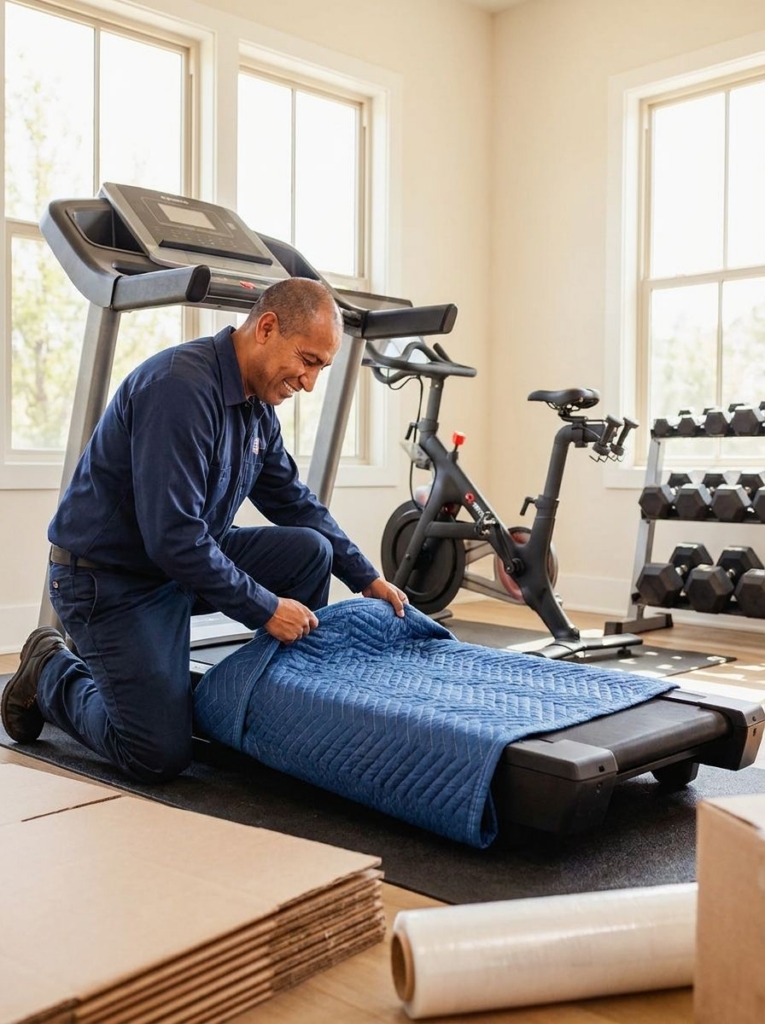
Protect the vulnerable areas: console, belt edges, frame corners, side rails, and plastic motor covers. Use moving blankets, cardboard edge guards, stretch wrap, and straps where appropriate. For broader packing principles, review how professionals pack and ship bulky household items.
Do not rely on thin plastic alone. Do not leave cords, keys, cup holders, or accessories dangling. Do not wrap directly against hot electronics immediately after use. Let the machine cool, then protect hard surfaces and fragile parts before loading.
How to Ship a Peloton, Elliptical, Weights, or Other Home Gym Equipment
To ship exercise equipment well, match the prep to the item.
For a Peloton or spin bike, protect the touchscreen first. Remove shoes, weights, water bottles, and accessories. Secure or remove pedals if needed. Stabilize the handlebars and seat post, and avoid placing any pressure on the screen. If you are researching how to ship a Peloton bike, ask whether the carrier has experience with connected fitness equipment.
Ellipticals need special attention because the arms and pedals move. Secure moving arms, lock or pad pedals, remove protruding parts where practical, and protect plastic shrouds and electronics. These machines can be tall and awkward even when partly disassembled.
Weights and dumbbells are dense. Ship them in strong containers or crates with the weight distributed evenly. Never overload standard cardboard boxes. A small box packed with plates can split open or injure someone.
Benches, squat racks, folding racks, and compact home gyms should be disassembled where practical. Label hardware, bundle compatible parts, and protect powder-coated surfaces from scraping. Cable gyms and rehab equipment may need photos before disassembly so they can be set up correctly later.
Dense weight sets can be expensive to move because carriers price by weight and handling difficulty, not just size. A few small boxes of iron may cost more than expected.
Is Shipping a Treadmill Worth It?
Shipping a treadmill is worth it when the machine’s value justifies the quote. Look at replacement value, condition, age, brand, sentimental or fitness value, and whether the same model is easy to buy at the destination.
Use this simple sell-vs-rebuy formula:
Expected shipping quote + packing and access costs compared with resale value loss + replacement price + delivery and setup at the destination.
Shipping usually makes sense for high-end treadmills, newer Peloton or premium spin bikes, specialized rehab equipment, or equipment traveling with other household goods. If you are sending a treadmill with a few boxes, a bench, furniture, or other gym items, a partial move may improve the value because you are not paying to move one awkward item by itself.
Selling locally may be smarter for older budget treadmills, machines needing repair, very difficult basement removals, or low resale-value equipment moving cross-country alone. A free or cheap treadmill can become expensive once labor, stairs, packing, and long-distance transport are added.
Get at least one real quote before deciding. Access details and service level can change the math significantly.
What to Have Ready Before You Request a Shipping Quote
For an accurate quote, have these details ready:
- Pickup and delivery ZIP codes
- Item make and model
- Folded and unfolded dimensions
- Estimated weight
- Photos from all sides
- Declared value
- Whether it is already packed, boxed, or palletized
Also be ready to answer access questions. Is the treadmill upstairs or in a basement? Are there elevators? How many stairs? Can a truck park nearby? Are doorways, landings, or turns tight? Does pickup or delivery require in-home placement?
Tell the carrier about fragile electronics, screens, previous damage, missing deck locks, unusual disassembly needs, or any part that feels loose. Surprises on pickup day can delay the shipment or change the price.
For heavy exercise equipment that is too large for FedEx or UPS but not enough for a full moving truck, request a small-load or white-glove shipping quote. The right service can protect the machine, simplify access problems, and give you a clearer answer before you sell, rebuy, or move it yourself.